





Home / Summer / Themed Trail / Religion and Rebellion
Defiant Salzkammergut
Religion and Rebellion
From religious tensions to carnival uprisings: Standing up against outside interference has a long history in the Salzkammergut.
History & Stories
Of Carnival Uprisings and Rebellion
People in the Salzkammergut have always been almost allergic to outside interference and patronizing rules. In fact, the history of the Salzkammergut is deeply shaped by unrest and revolts.
The new teachings of Protestantism spread very quickly across the Salzkammergut. “As in many mining regions, Lutheranism quickly gained followers; as early as the 1520s, Gmunden, for example, was considered a ‘Lutheran nest.’ The Protestants held onto their faith all the more steadfastly, so that the onset of the Counter-Reformation at the end of the century met with extreme resistance.”
In Bad Aussee, street celebrations were apparently once banned—so the festivities were simply moved up to the rooftops. In Ebensee, things went so far as a full-blown “Carnival Uprising” in 1733.
In addition to religious tensions, the region faced severe climate challenges. Following a medieval warm period, Europe experienced a “Little Ice Age.” Particularly in the 17th century, the climate worsened noticeably in the Salzkammergut as well. Naturally, this heavily impacted food supplies for the local population, who increasingly had to rely on much more expensive imports.
Historical themed trail article
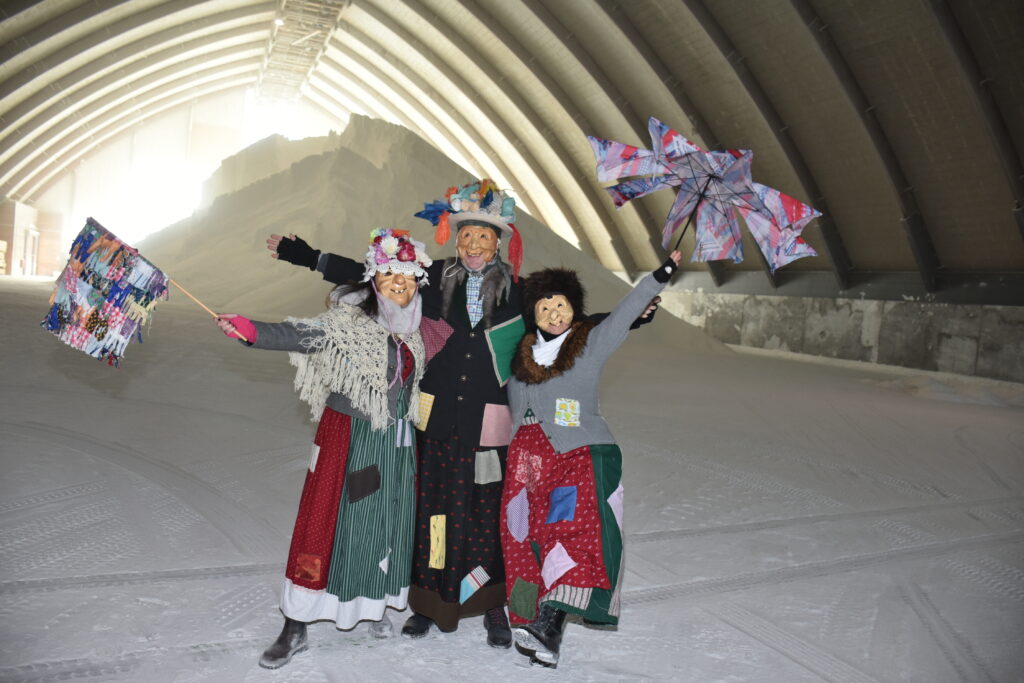
Carnival in Ebensee · Anita Kahr / Salinen Austria AG · Image from the original chapter
History & Stories
Uprisings in Historical Perspective
“As early as 1392, there was an uprising in Lauffen and Hallstatt against their ruler, Duke Albert III. Citizens and coopers, miners and weir workers (in Steeg) and others are mentioned. The punishments imposed by the duke were severe: several rebels were blinded and hanged, others were thrown into dungeons for years, while the rest submitted and pledged obedience.” Gerhart Baron: Der Beginn. Die Anfänge der Arbeiterbildungsvereine in Oberösterreich. Linz, 1971, p. 46.
“In the very delicate 1730s, the so-called ‘Shrove Tuesday Revolt’ also broke out in the Salzkammergut. In the volatile year of 1733—amidst religious turmoil and just one year before the expulsions to Transylvania began—the salt mine administration completely unnecessarily provoked the workers’ fury. Traditionally, workers were given time off at 12:00 PM on Shrove Tuesday with full day’s pay so they could celebrate. In an overzealous bid to cut costs, management sought to save these expenses of around 36 guilders for the entire workforce in Ischl (470 people). This unwise decision, affecting only a negligible budget item, was the straw that broke the camel’s back. On Carnival Saturday, workers left their jobs early, gathered outside the administrative building […] and demanded […] the preservation of their longstanding tradition. Seeau, the chief salt official in Gmunden, caught wind of the situation, and because the unrest came at an inopportune time when a religious revolt was brewing, he overturned the petty decree, restoring the afternoon off on Shrove Tuesday as before.” Michael Kurz: Salzkammergut-Geschichte(n). Von der Industrie- zur Welterbelandschaft. Bad Ischl, 2005, p. 204.
Historical themed trail article
Further Information
Read & Listen Further
. Here you will find useful links to relevant museums, cultural offerings, and media, as well as the shared themed trail audio guide.
More at Salzkammergut Tourism › To the audio guide ›Continue along the themed trail