





Home / Summer / Themed Trail / Defiance in the Salzkammergut
Defiant Salzkammergut
Defiance in the Salzkammergut
Salt production, isolation, and community: The themed trail explores the historical roots of the region's spirit of resistance.
History & stories
Community and authority
This spirit of resistance naturally has historical roots. The rugged landscape, the unique working conditions of salt production, and close family ties fostered a strong sense of community and a distinct mindset—people simply had to rely on one another. When the Salzkammergut was taken from the immensely wealthy local salt administrators ("Salzverweser") and placed directly under the imperial court in Vienna as crown land ("Kammergut"), it sparked centuries of resentment and discontent. Thanks to its secluded location, the region was largely spared from warfare, and its inhabitants were exempt from all taxes and military service until World War I. Their skills and specialized expertise were simply too lucrative and valuable for the state treasury. Entering or leaving the region was also forbidden and strictly controlled. At the same time, the local population was kept on a very tight leash, often enduring great hardship and hunger.
Historical themed trail post
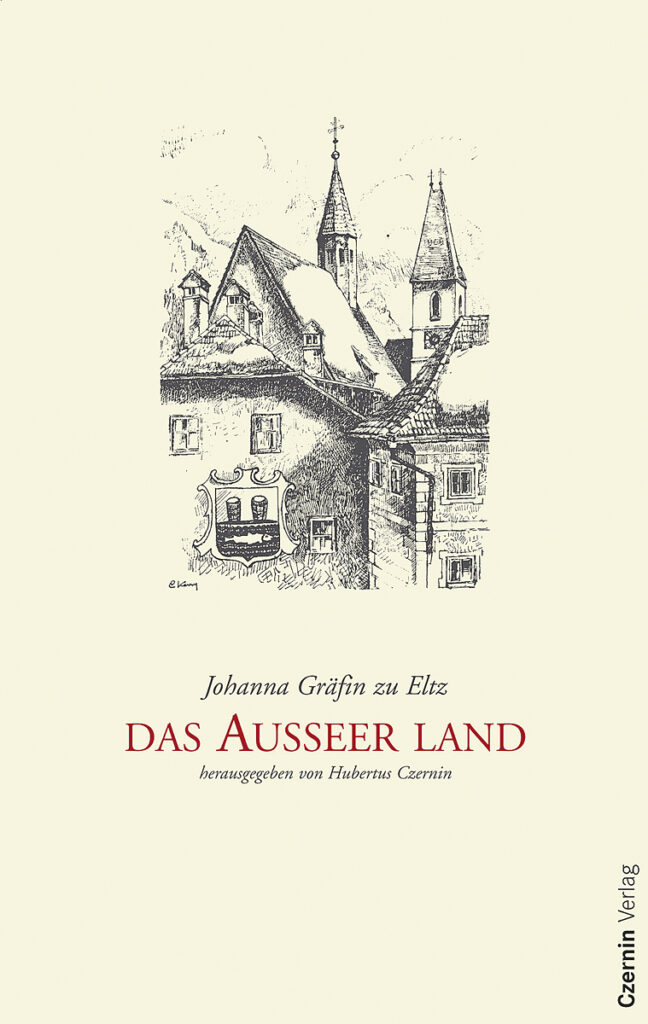
"Das Ausseer Land" · Book cover from the original chapter · © Kulturfux
History & stories
The Hallinger in a historical narrative
Countess Johanna zu Eltz, née Countess Schönborn-Wiesentheid, writes in her book "Das Ausseer Land" about the development of the legendary noble lineage of the Hallinger and the self-confidence of the Aussee locals:
“It appears that the Hallbergs […] were a native noble family. Their original name was likely derived from Hallingern. Even the Greek historian Ptolemy mentions the Halani, Helones, a people who inhabited the Noric Alps near inland lakes. […] The root ‘Hal’ refers to salt. Later on, Hallinger became the title for the owners of salt deposits, salt shafts, and salt springs. They were united in this cooperative and oversaw the operation of the salt mountain and the boil-houses. The office of the Hallamt was inherited through the male line, while the boil-houses could also pass to daughters and collateral relatives. […] Documents from around 1500 attest to the immense wealth of the Hallinger. Among the oldest of these Hallinger families were the Khalß or Khälß. But times changed. A patent of nobility from 1449 states: ‘As there was a great shortage of salt at this time, Emperor Frederick III took the salt industry away from the Hallingern.’ ” “Even today, you can still tell by looking at many an Altaussee local that his ancestors were Hallinger. His self-assured demeanor gives it away. He himself knows nothing of it.” Countess Johanna zu Eltz: Das Ausseer Land. Österreichischer Verlag für Belletristik und Wissenschaft, Linz, 1947. Self-published reprint by Erhard Beuchl/Peter von Kuczkowski. Altaussee, 1981.
The passage about the Hallinger is a historical quote from "Das Ausseer Land" by Countess Johanna zu Eltz (1947; reprint 1981).
Historical themed trail post
Further information
Read & listen more
. Here you'll find helpful links to museums, cultural offerings, and media, as well as the themed trail's shared audio guide.
More from Salzkammergut Tourism › Kammerhofmuseum Bad Aussee › To the audio guide ›Continue along the themed trail