







Home / Summer / Theme Trail / Tradition and Identity
Rebellious Salzkammergut
Tradition and Identity
“uboasch, haftig, and gschmå”: A shared sense of community and subtle differences in dialect shape the identity of the Salzkammergut.
History & Stories
A Strong Sense of Community
Even though the Salzkammergut stretches across three federal states, there is undoubtedly a shared Salzkammergut identity – a very strong sense of community! Throughout history, the people of the Salzkammergut were often not treated well by the authorities. A strong sense of togetherness emerged from what was often great hardship. When someone comes from the outside, people stick together!
Looking closer, however, one still cannot speak of ONE uniform mentality among Salzkammergut residents. The individual towns and even the different neighborhoods are too diverse, differing even by nuances in language. Dialect still plays a major role here. Historically, the various parts of the Salzkammergut took on different tasks: highly specialized miners lived in Altaussee, while in Bad Aussee, workers toiled at the boiling pans in the hellishly hot saltworks, while the already proud middle class strolled nearby. In Hinterberg (today's Bad Mitterndorf), the woodcutters, among others, lived.
Historical theme trail contribution
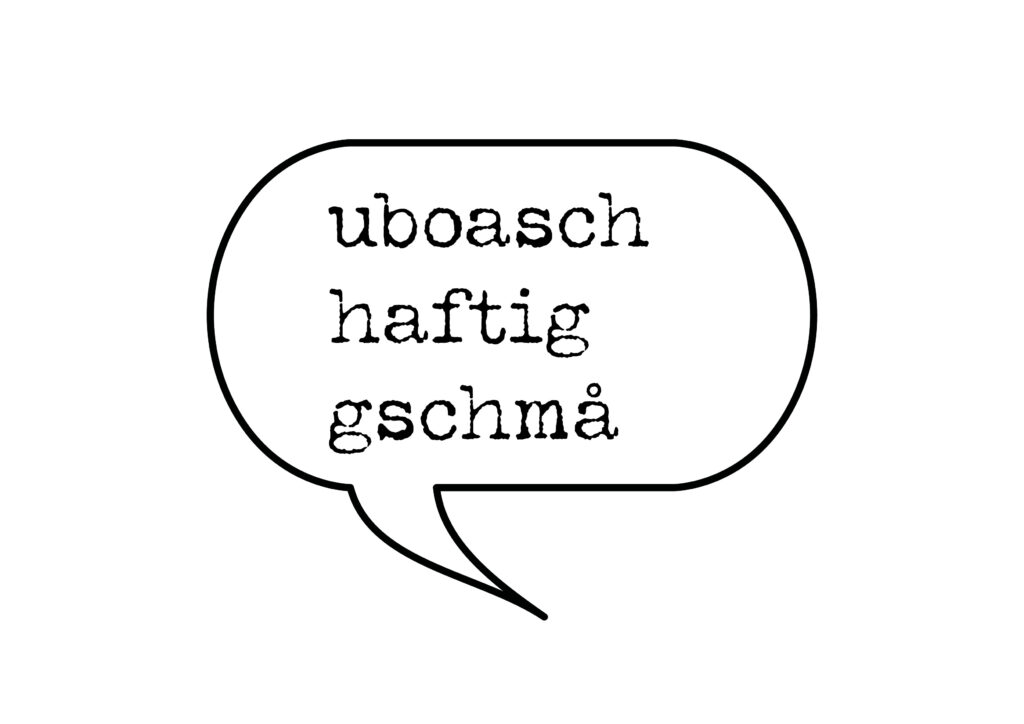
Illustration from the original chapter of the theme trail
History & Stories
Dialect as the Language of Proximity
Identity through language! Linguist Prof. Dr. Hannes Scheutz explains:
Dialect is the language of proximity – the language of familiar interaction with one another, the language within a small group – in the family, in the village, in the town. That is what dialect is for, and that is why we love and value it. [...] In the future, it might no longer be possible to distinguish whether a speaker in Ischl comes from Perneck or Wirling, and perhaps one will no longer be able to tell an Ischl speaker from a Goisern speaker. But nevertheless, there will be regional forms that fulfill this function as before, so that regional and social identity can be recognized and anchored in them – as a language of proximity.
Prof. Dr. Hannes Scheutz, Linguist at the University of Salzburg
This chapter is dedicated to the topic of “Identity.”
Historical theme trail contribution
Further information
Read & listen more
. Here you will find links to relevant museums, cultural offerings, and media, as well as the shared audio guide for the theme trail.
Prof. Dr. Hannes Scheutz › Salzkammergut Language Atlas › Salzkammergut Dialect Quiz › Read more at dachstein.salzkammergut.at › To the audio guide ›Continue the theme trail